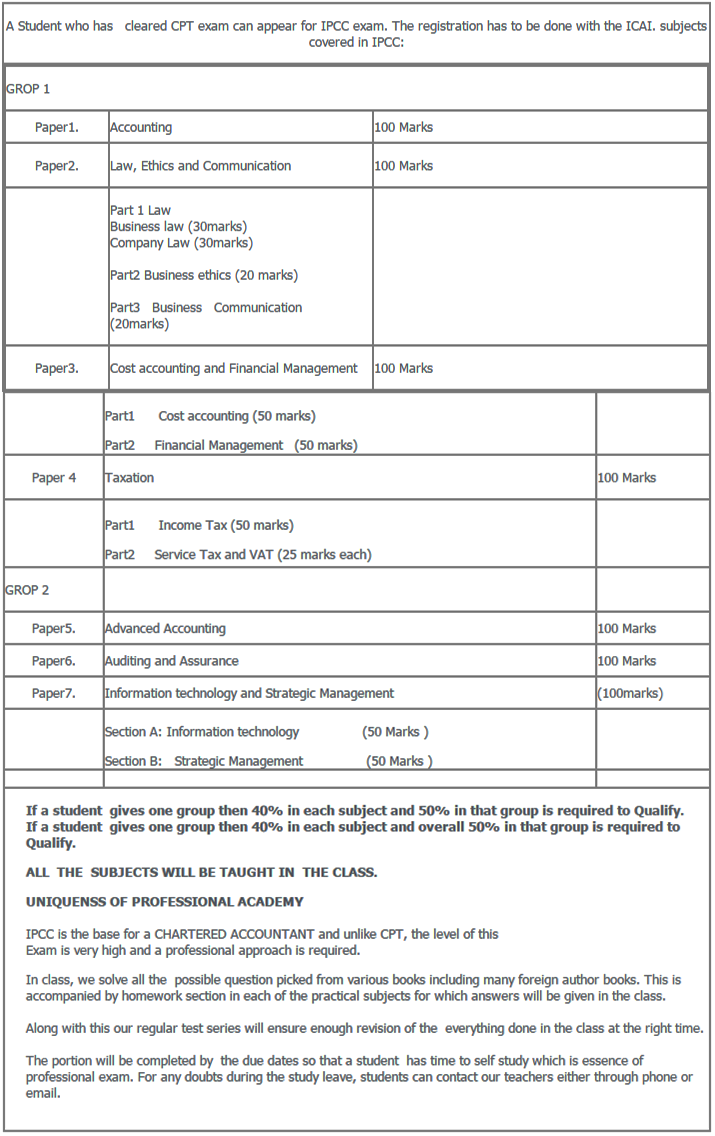
Subsequent to clearing the CPT exam, students can appear for IPCC exam after nine months of preparation. The IPCC exam has subjective questions based on law, audit, tax, etc as compared to the objective questions in the CPT exam.
After clearing the IPCC exam, a student has to serve as an intern under a practicing CA for a period of three years before being eligible to appear for the final exam.
IPCC( Integrated Professional Competence Course) is the second level of CA examination.After Clearing the CPT test student have to give ipcc exam. This exam is divided into two groups or sections. Both these groups are can be studied separately or combined.
Practical training or articleship
This level of CA education focuses on the need for practical knowledge along with theoretical aspects. A student would undergo theoretical education and 3 years of practical training after passing Group-I of IPCC/Accounting Technician (Level-1). A student has to register and undergo orientation program & 100 hours ITT before appearing in Integrated Professional Competence Examination/Accounting Technician Examination.
Group I (Two hours- 100 Marks)
PAPER I: Accounting
( Maximum Marks 100)
It cover General knowledge of the framing of the accounting standards, national and international accounting authorities, adoption of international financial reporting standards, Accounting Standards-1, 2, 3, 6, 7, 9, 10, 13 and 14, company accounts, Self-balancing ledgers, Financial Statements of Not-for-profit-organization, Accounts from incomplete records, Accounting for special transactions, issue in partnership accounts and accounting in computerized environment.
PAPER II: Law,Ethics and Communication
Maximum Marks 100
This paper has been divided in three parts:
Law (60 Marks)-
covers the practical application of business law including Indian Contract act, Negotiable instrument act, Payment of bonus act etc and provisions of company law covering The Companies Act from section 1 to 197
Ethics (20 Marks)
provides understanding of ethical issues in business including environmental issues, ethics in workplace, Marketing & Consumer protection and Accounting & Finance.
Communication (20 Marks)
covers development of behavioral skills and communication relating to business covering elements like Communication, Communication in Business environment and basic understanding of legal deeds and documents.
PAPER III: Cost Accounting and Financial Management
Maximum Marks 100 This paper has been divided in two parts:
Cost accounting (50 Marks):
covers the concepts and processes to determine the product cost like material,
labors, overheads, process costing, contract costing etc and includes marginal
costing and standard costing for decision making
PAPER IV: Taxation
Maximum Marks 100
This paper has been divided in two parts:
Income tax (50 Marks):
covers the income under five heads namely salaries, house property, capital
gains, profit and gain from business and profession and other sources
Service Tax, VAT, EXcise Duty, Custom Duty and CST (50 Marks):
covers the provisions of all of the above taxes like payment of tax and
filling of returns and concepts of Value Added Tax etc.
Group II
PAPER V:Advanced Accounting Maximum Marks 100
It cover Conceptual framework for preparation & presentation of financial statements, Application of accounting standards 4,5,11,12,16,19,20,26 and 29, Cases relating to company accounts, advanced issues in partnership accounts and accounting for special transactions.
PAPER VI:Auditing and Assurance
Maximum Marks 100
It cover Generally Accepted Auditing Procedures, techniques and skills like verification and vouching of assets & liabilities, company audit, auditing standards needed to understand the objective and concepts of auditing and to apply them in audit and attestation processes.
PAPER VII: Information Technology and Strategic Management
Maximum Marks 100
This paper has been divided in two parts:
Information technology (50 Marks):
covers an introduction to computers, Data base management systems, computer
networks and network security, internet & other technologies and decision tree
flow charts
Strategic Management (50 Marks):
covers business environment and strategies of business like Strategic
Analyses, Strategic Planning, Implementation & control etc.
Statutory audit
Internal audit
Compulsory tax audit
Certification and audit